
Fuel Economy on the Highway vs. Around Town: What's Really Different
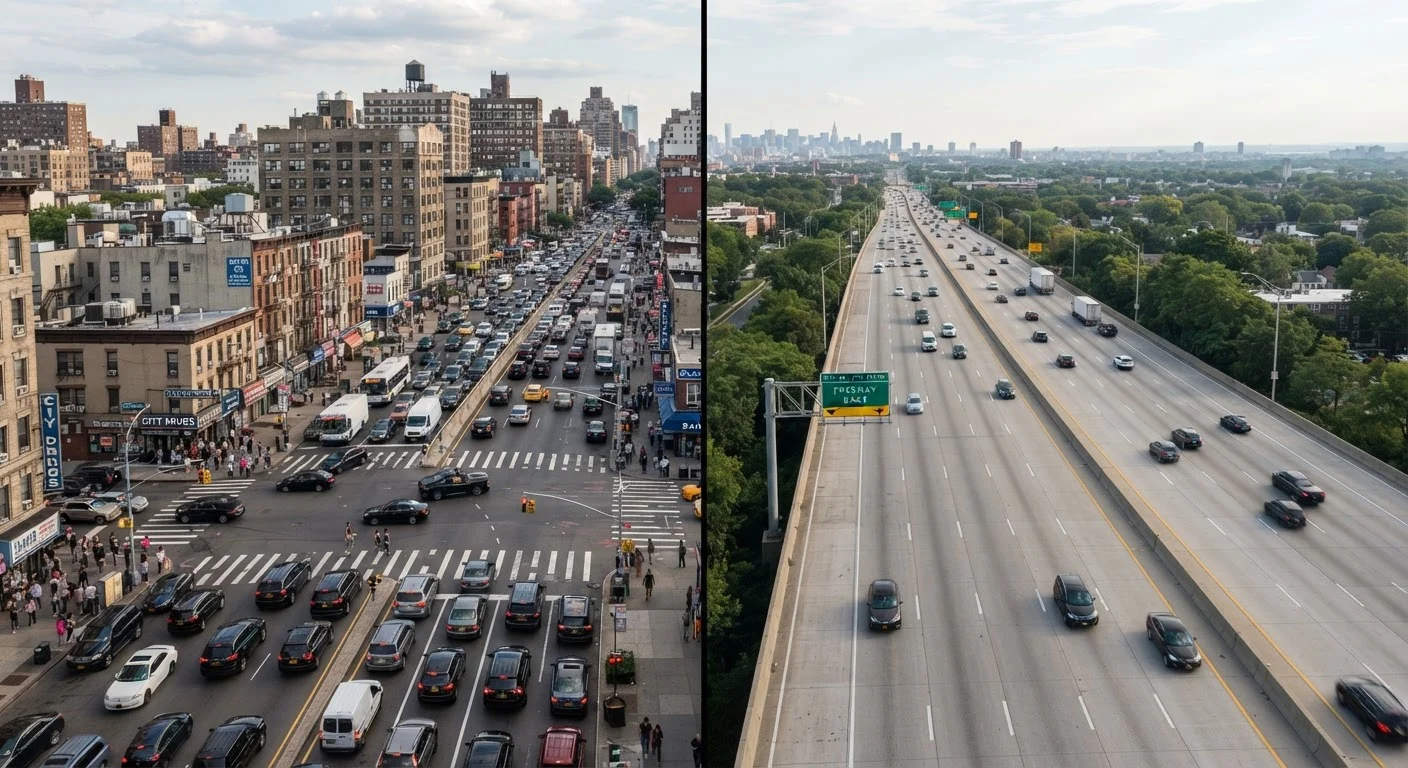
Photo credit: SmartReads.net | Simple Search, Relevant Results
In this article
City and highway driving burn fuel in fundamentally different ways. Understand the physics behind each to drive more efficiently in both settings.
Key Takeaways
- City driving burns more fuel per mile due to frequent acceleration, braking, and idling.
- Highway driving is generally more efficient but aerodynamic drag increases significantly above 55 mph.
- Smooth acceleration and anticipating traffic are the most effective habits in either setting.
- Hybrids and EVs close much of the efficiency gap in city conditions through regenerative braking.
- Your vehicle's EPA ratings reflect these two contexts separately - neither figure reflects real-world mixed driving exactly.
Why City and Highway Driving Are Fundamentally Different Problems
When you see two numbers on a vehicle's fuel economy label - one for city, one for highway - they're not just marketing categories. They reflect two distinct physics problems your engine has to solve.
In city driving, the dominant fuel drain is kinetic energy loss. Every time you accelerate from a stop, your engine burns fuel to build speed. Every time you brake, that energy is shed as heat rather than being stored or reused. Idling adds another layer: a parked-but-running engine consumes fuel while moving the vehicle exactly zero miles. Taken together, these factors mean city driving consistently delivers lower fuel economy than highway driving for most conventional gasoline vehicles.
Highway driving removes most of those variables. You're accelerating once, maintaining a steady cruising speed, and rarely braking. The engine settles into an efficient operating range. But a new problem emerges: aerodynamic drag. Drag increases with the square of speed, meaning the jump from 55 mph to 75 mph doesn't just cost you a little more fuel - it costs significantly more. Understanding how your MPG display works helps clarify why your readout often drops on fast highway runs even when conditions feel smooth.
Head-to-Head: City vs. Highway Fuel Dynamics
The table below breaks down the core factors that distinguish these two driving environments across dimensions that actually move the fuel needle.
| Criterion | City Driving | Highway Driving |
|---|---|---|
| Primary fuel drain | Acceleration & braking losses | Aerodynamic drag |
| Idling impact | High - frequent stops and queues | Low - minimal stopping |
| Engine operating range | Variable, often inefficient range | Steady, typically efficient range |
| Speed effect on efficiency | Low speeds; drag is not the issue | Drag rises sharply above 65 mph |
| Hybrid/EV advantage | Significant - regen braking helps | Moderate - less regen opportunity |
| Key driver habit | Smooth acceleration, anticipate stops | Steady speed, cruise control use |
| Typical EPA efficiency vs. highway | Lower MPG rating | Higher MPG rating (conventional engines) |
One nuance worth noting: the city/highway efficiency gap narrows considerably in hybrid and electric vehicles. Regenerative braking - which captures kinetic energy during deceleration and stores it as electricity - means hybrids can actually outperform some of their own highway ratings in dense stop-and-go traffic. For conventional gasoline vehicles, that reversal almost never happens.
EPA Ratings Are Test-Cycle Estimates
The city and highway MPG figures on a vehicle's window sticker are produced under controlled laboratory test cycles, not real road conditions. Actual fuel economy varies with driving style, temperature, vehicle load, and terrain. The EPA's combined rating - a weighted average of the two figures - is generally the most useful single number for comparing vehicles, but neither figure should be treated as a guarantee of what you'll see at the pump.
Practical Habits That Pay Off in Each Setting
In the city: The biggest lever is how you manage acceleration. Gradual, steady acceleration from stops keeps fuel flow lower than aggressive bursts. Equally important is anticipation - reading traffic signals ahead of you and coasting to a natural slowdown rather than braking hard. Smooth acceleration and braking technique can realistically improve city fuel economy by several percentage points without any hardware changes.
Idling is another major city drain. Modern fuel-injected engines use virtually no fuel when you're coasting or decelerating with your foot off the gas, but they do consume fuel sitting stationary. If you expect to be stopped for more than a minute or two, shutting off the engine - or relying on a start-stop system if your vehicle has one - is worth the habit. See our related piece on idling and other hidden fuel drains for a fuller breakdown.
On the highway: Speed discipline is the primary tool. Most vehicles reach peak efficiency somewhere in the 50-65 mph band. Cruise control helps by eliminating the small, repeated speed variations that human foot-on-pedal driving naturally introduces. Before a long haul, running through a pre-trip fuel efficiency checklist - covering tyre pressure, roof rack removal, and fluid levels - can provide meaningful gains over a full tank.
~14%
Fuel economy drop from 55 to 75 mph
The U.S. Department of Energy estimates that fuel economy decreases roughly 7-14% for each 5 mph driven above 50 mph, depending on the vehicle.
3-10%
Efficiency gain from smooth driving
The U.S. Department of Energy attributes aggressive driving - rapid acceleration and hard braking - as reducing fuel economy by 10-40% in stop-and-go conditions.
For multi-day trips, strategic refuelling matters too. Planning fuel stops around terrain and traffic rather than just distance can reduce how often you're running the engine hard in suboptimal conditions.

Author
Autos Editorial Team
Autos Editorial Team is the collective byline for our editorial team and contributor network. Articles published under this byline or an editorial pen name are researched, written, and reviewed according to our editorial standards for clarity, consistency, and independence before publication.
View all articles →