
Foods Labelled 'Healthy' That Nutritionists Look at More Carefully
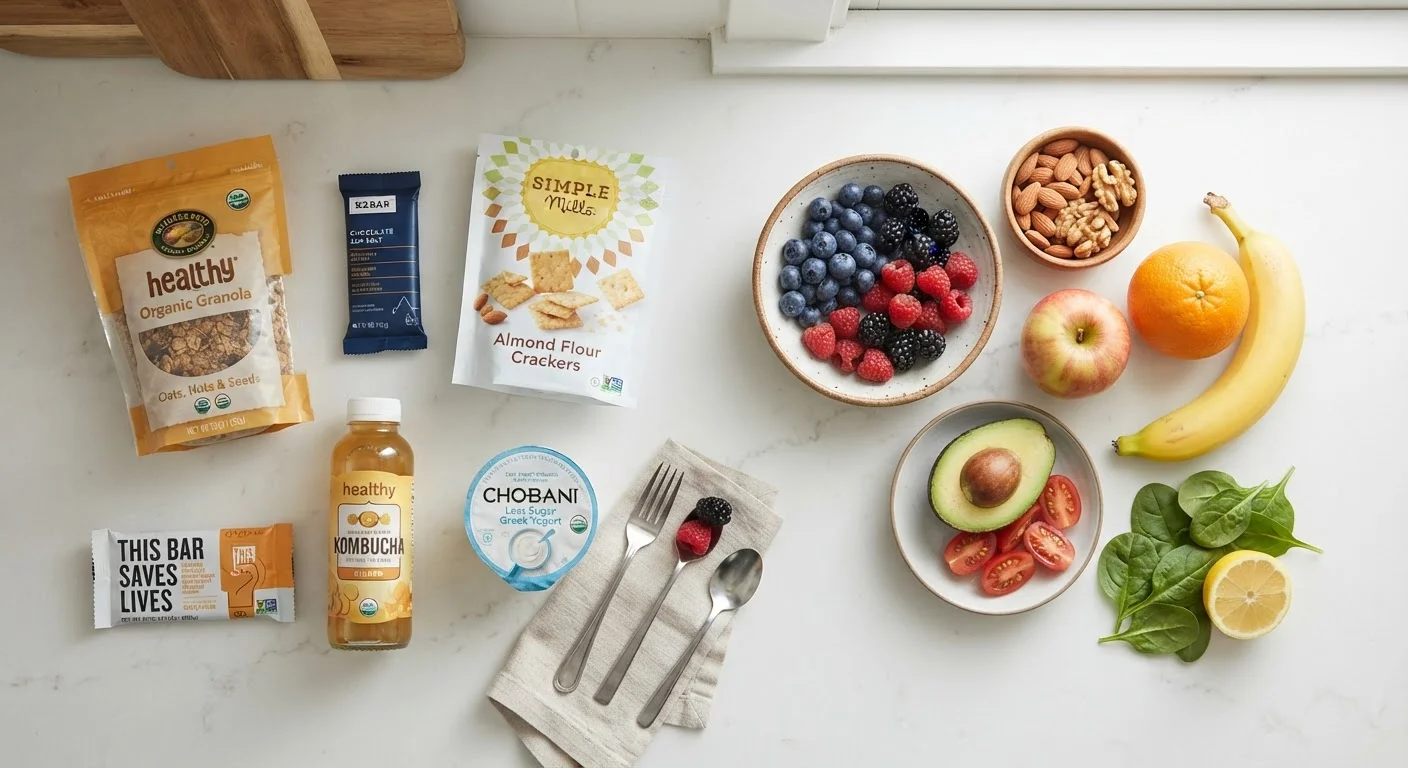
Photo credit: SmartReads.net | Simple Search, Relevant Results
In this article
Granola bars, fruit juices, low-fat snacks — some 'healthy' labels deserve a second look. Here's what the science actually shows.
Key Takeaways
- Marketing terms like 'natural' and 'low-fat' have limited regulatory definition and don't guarantee nutritional quality.
- Many foods widely seen as healthy - granola, fruit juice, flavored yogurt - can carry significant added sugar.
- Reading the nutrition facts panel and ingredient list tells you far more than front-of-package claims.
- Context matters: a food's overall role in your diet matters more than any single label claim.
- Consulting a registered dietitian can help you sort evidence-based choices from marketing noise.
Why 'Healthy' on a Package Means Less Than You Think
Walk through any grocery store and you'll see the word healthy on dozens of packages - granola bars, flavored waters, low-fat crackers, plant-based snacks. The problem is that in the U.S., front-of-package health claims are only loosely regulated. Terms like natural, clean, or wholesome carry no standardized legal definition under FDA rules, meaning manufacturers can use them with considerable latitude.
That gap between perception and reality is where busy professionals - already overwhelmed by food choices - can get quietly misled. The myth-versus-fact pairs below focus on the foods most commonly misread as automatically healthy, and what the nutrition evidence actually shows. For a deeper look at decoding what's actually on the label, see our guide to reading nutrition labels.
Myth
Fruit juice is a healthy alternative to soda because it comes from fruit.
Fact
Most fruit juices deliver a concentrated sugar load with little fiber - a nutritional profile closer to sweetened beverages than to whole fruit.
Whole fruit packages its natural sugars alongside fiber, water, and micronutrients that slow absorption and support satiety. Juicing strips most of that fiber away. A standard 8-ounce glass of 100% orange juice contains roughly 21-24 grams of sugar - comparable to many sodas - without the fiber that would otherwise blunt the blood glucose response. Research published in nutritional epidemiology consistently finds that whole fruit consumption is associated with better metabolic outcomes than juice consumption. Treating juice as an occasional drink rather than a daily staple is a simple, science-supported adjustment.
Myth
Low-fat or fat-free products are automatically better for you.
Fact
Removing fat often means adding sugar, starch, or salt to restore palatability - sometimes making the product nutritionally worse overall.
The low-fat era of the 1980s and 90s produced a generation of products that swapped saturated fat for refined carbohydrates and added sugars. Dietary science has since moved on: current evidence distinguishes sharply between fat types and recognizes that unsaturated fats (found in nuts, avocado, olive oil) support cardiovascular health. A low-fat flavored yogurt, for example, may contain more added sugar than a full-fat plain version. Check the ingredient list - if sugar or a starch derivative appears in the first few ingredients to compensate for removed fat, the trade-off may not be worth it.
Myth
Granola is a nutrient-dense breakfast choice because it contains oats, nuts, and dried fruit.
Fact
Commercial granola is frequently high in added sugars and calorie-dense fats; ingredients like oats and nuts don't offset that unless the sugar content is genuinely low.
Oats and nuts are legitimately nutritious. The issue is what binds them together in most commercial granola: honey, brown sugar, maple syrup, or refined oils, often in substantial quantities. A single half-cup serving of many popular granolas contains 8-13 grams of added sugar - and half a cup is a modest amount that most people exceed. Comparing labels within the granola category or choosing plain rolled oats with your own toppings gives you the fiber benefits without the hidden sugar load.
Myth
Anything labeled 'natural' is less processed and therefore healthier.
Fact
The FDA has not defined 'natural' for food labeling in a way that restricts processing, artificial ingredients, or added sugars - making the term largely meaningless as a health indicator.
As of current FDA guidance, the agency has not formally prohibited the use of natural on foods that contain added colors, artificial flavors, or synthetic substances - it primarily applies the term to mean nothing artificial or synthetic has been added, but that standard is not consistently enforced across categories. 'Natural' flavors, for instance, simply refers to the original source of a flavoring compound, not to how extensively it was processed in a lab. A product can be labeled natural while being heavily processed, high in sodium, or loaded with concentrated sweeteners. The ingredient list remains the most reliable source of information.
Myth
Plant-based snacks and protein bars are healthy because they avoid animal products.
Fact
Plant-based origin says nothing about added sugar, sodium, refined oils, or ultra-processing - all of which are common in packaged plant-based snacks.
Plant-based eating patterns supported by evidence - like Mediterranean and whole-foods approaches - emphasize minimally processed vegetables, legumes, whole grains, and nuts. That's meaningfully different from a plant-based protein bar held together with sugar syrups and processed isolates. The NOVA food classification framework, developed by nutrition researchers at the University of São Paulo, categorizes foods by degree of processing rather than nutrient composition alone - and many plant-based packaged products land firmly in the ultra-processed category. The health value of plant-based eating comes primarily from whole or minimally processed plants, not from processed products that happen to exclude animal ingredients.
How to Apply This at the Grocery Store
Knowing which halos are false is useful; knowing what to do instead is more useful. A few practical habits close the gap quickly.
~73%
of packaged foods carry at least one health claim
Research published in the Journal of the Academy of Nutrition and Dietetics found the large majority of US packaged food products carry some form of front-of-package health or nutrition claim.
17 tsp
Average daily added sugar consumed by US adults
CDC surveillance data indicates Americans consume roughly 17 teaspoons of added sugar per day on average - more than double the American Heart Association's recommended limit for women.
57%
of US calories come from ultra-processed foods
A nationally representative study published in BMJ Open estimated that ultra-processed foods account for more than half of all calories consumed by US adults.
Flip before you buy. The front of a package is advertising. The nutrition facts panel and ingredient list on the back are data. Prioritize added sugars (aim low), fiber (aim higher), and the first three ingredients - they make up the bulk of what you're eating.
Compare within a category. Two granola bars can differ by 10 grams of added sugar. Two flavored yogurts can differ by 15 grams. A quick side-by-side takes seconds and is one of the highest-return habits you can build.
Watch serving sizes. Many products look moderate in sugar or sodium until you notice the serving is half the container you'd realistically eat in one sitting.
Don't Let Label-Checking Become a Stressor
Scrutinizing every package can tip into anxiety around food - which research suggests is counterproductive to long-term healthy eating. Aim for informed awareness, not perfectionism. Applying a label check to your most-frequent purchases is enough to make a meaningful difference without adding decision fatigue to your day.
If you're working on a specific health goal - weight management, blood sugar stability, heart health - an individualized review with a registered dietitian will always outperform any general article, including this one. Use the weekly eating audit as a low-pressure self-check between professional visits. For a broader view of evidence-informed eating patterns, our overview of Mediterranean, plant-forward, and whole-foods approaches is a helpful starting point.
This article is for general informational purposes only and does not constitute medical or nutritional advice. Please consult a qualified healthcare professional or registered dietitian for guidance specific to your health needs.

Author
Diet & Meal Plans Editorial Team
Diet & Meal Plans Editorial Team is the collective byline for our editorial team and contributor network. Articles published under this byline or an editorial pen name are researched, written, and reviewed according to our editorial standards for clarity, consistency, and independence before publication.
View all articles →