
Smartwatches, Fitness Trackers, and Smart Rings: What Each One Actually Does
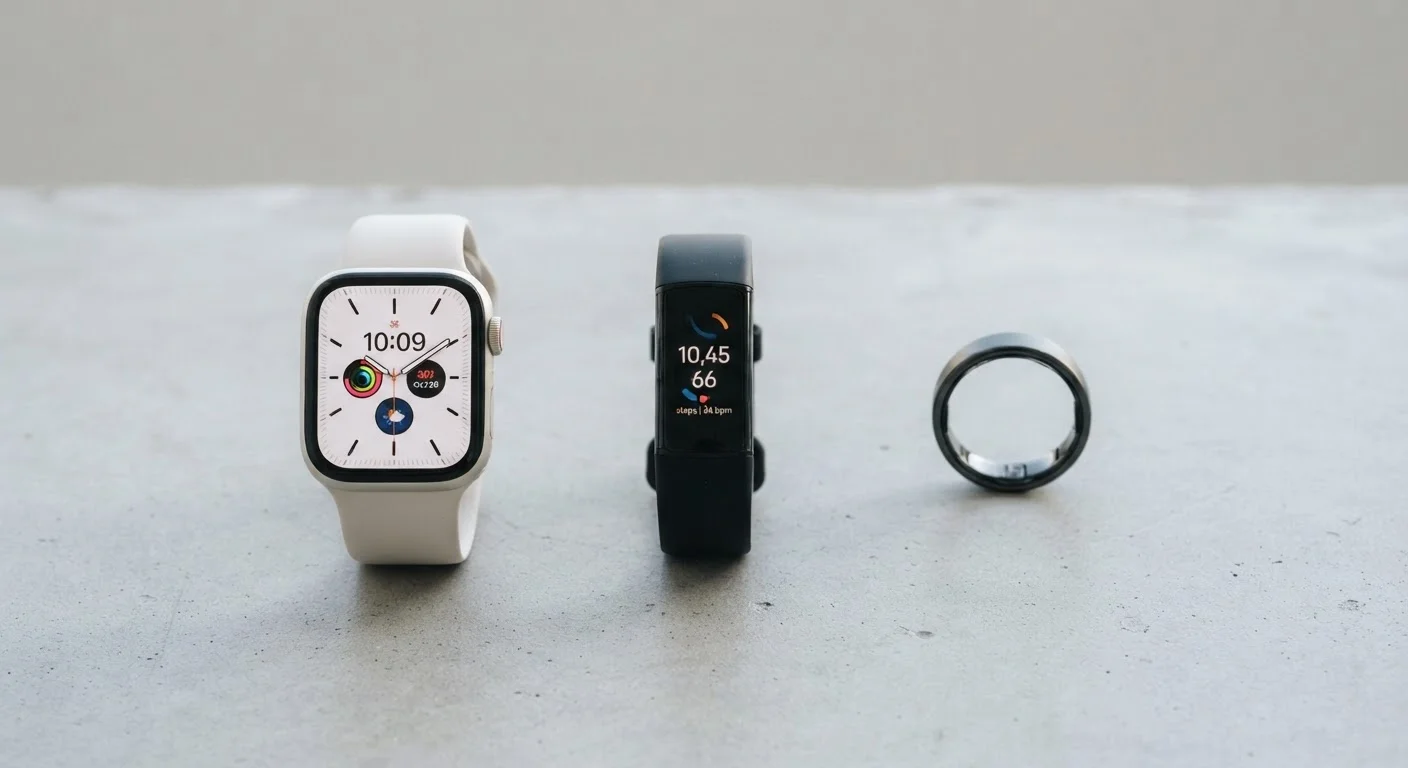
Photo credit: SmartReads.net | Simple Search, Relevant Results
In this article
Not all wearables serve the same purpose. Learn what differentiates smartwatches, fitness trackers, and smart rings before deciding which fits your life.
Key Takeaways
- Smartwatches prioritize communication, apps, and real-time alerts alongside health tracking.
- Fitness trackers focus on movement and health metrics with simpler interfaces and longer battery life.
- Smart rings are the most discreet option, optimized for passive health monitoring and sleep data.
- Your lifestyle, professional context, and comfort preferences should drive which category you choose.
- Many users find one device sufficient; some combine two for complementary data.
Why the Category Distinction Matters
Walk into any electronics retailer - or scroll through any tech publication - and wearables are often grouped together as if they serve identical purposes. They don't. Smartwatches, fitness trackers, and smart rings are built around fundamentally different design priorities, and choosing the wrong category means paying for features you'll never use or going without ones you actually need.
For busy professionals, this distinction is especially practical. Your wrist real estate is limited. Your attention is limited. Understanding what each device category is actually engineered to do saves time, money, and frustration. See our starter's field guide to wearables if you're new to the space and want to cover foundational concepts first.
Smartwatches: A Connected Computer on Your Wrist
Smartwatches are the most feature-dense category. At their core, they function as an extension of your smartphone - surfacing notifications, enabling quick replies, running lightweight apps, and often supporting mobile payments via NFC (near-field communication, the technology behind tap-to-pay). Most current models also include a substantial health-monitoring suite: continuous heart rate, blood oxygen (SpO2), ECG (electrocardiogram) capabilities, and sleep tracking.
The trade-off for this capability is battery life. Most smartwatches require daily or every-other-day charging. The always-on display feature - useful for glancing at the time without a wrist flick - accelerates drain further. Understanding the always-on display trade-off is one of the first practical decisions smartwatch owners face.
Smartwatches suit professionals who want one device to handle communication, scheduling nudges, and fitness data simultaneously - and who don't mind charging nightly.
| Smartwatch | Fitness Tracker | Smart Ring | |
|---|---|---|---|
| Primary purpose | Connectivity + health tracking | Activity + health monitoring | Passive biometric sensing |
| Notifications & apps | Yes - full app ecosystem | Limited or none | None |
| Display | Full touchscreen | Small screen or LEDs | No display |
| Battery life | 1-2 days typical | 5-14 days typical | 4-7 days typical |
| Form factor | Watch-style, visible | Slim band, low-profile | Ring, nearly invisible |
| Sleep tracking comfort | Moderate - bulkier | Good - slim band | Excellent - lightweight |
| Health sensor range | Broad - ECG, SpO2, HRV | Moderate - HR, HRV, SpO2 | Focused - HR, HRV, temp |
| Best context | On-the-go professionals | Fitness-focused users | Discreet or sleep monitoring |
Fitness Trackers: Focused Health Monitoring, Fewer Distractions
Fitness trackers strip away most of the smartphone-extension functionality and concentrate on what their name implies: tracking physical activity and health metrics. Expect step counts, distance, calorie estimates, heart rate, sleep stages, and often stress indicators based on heart rate variability (HRV - a measure of variation between heartbeats, associated with recovery and stress load).
The simplified feature set yields meaningful benefits. Battery life on many trackers extends to five to fourteen days. The form factor is usually slimmer and lighter. And without a constant stream of app notifications, the device doesn't compete for your attention the way a smartwatch can.
Consistency Beats Sensor Precision
The most accurate health data comes from consistent wear, not the most sophisticated sensor. A fitness tracker worn every day for a month gives more actionable trends than a premium smartwatch worn intermittently. Choose the device you'll actually keep on - that's the deciding factor most specs sheets won't tell you.
Fitness trackers are well suited to professionals who want health data without the cognitive overhead of a second screen - or who spend time in meetings or client-facing environments where a chunky smartwatch display feels out of place.
Smart Rings: Passive Sensing, Minimal Presence
Smart rings are the newest mainstream category and the most specialized. They contain sensor arrays - typically optical heart rate sensors, accelerometers, and skin temperature monitors - packed into a ring worn on a finger. There is no display. There are no notifications. The ring collects data continuously and syncs to a companion smartphone app, usually via Bluetooth.
Because finger capillaries are closer to the skin surface than those at the wrist, some researchers suggest finger-based optical sensors may capture certain biometric signals with higher fidelity, though consumer-grade accuracy still carries limitations regardless of form factor. For a grounded look at what wearable sensors can and cannot reliably measure, see what your wearable data actually means.
Battery life typically runs four to seven days. The primary appeal is discretion: no glowing screen, no alerts, no social signal. It functions as a passive health logger. Smart rings are particularly popular for sleep monitoring, since they're comfortable to wear overnight and don't emit light.
How to Match the Device to Your Life
Rather than asking which wearable is objectively better, ask which problem you're actually trying to solve:
- Need to stay connected without pulling out your phone? A smartwatch handles notifications, calendar reminders, and quick responses more fluidly than any other category.
- Want consistent health data without device fatigue? A fitness tracker's longer battery life and simpler interface make it easier to wear consistently - which matters more for data quality than any single sensor specification.
- Prefer to track health passively without changing your style or daily routine? A smart ring is invisible in most social and professional contexts and requires minimal interaction.
- Already own a smartwatch and want richer overnight data? Some users pair a smartwatch for daytime use with a smart ring for sleep - though managing two devices and two apps adds its own overhead.
Once you've chosen a device, configuration is what determines whether it actually fits your schedule. Setting up your wearable to match your routine walks through personalizing goals and managing alerts so the device works with your day, not against it. And if you've heard claims about wearables detecting heart attacks or counting calories precisely, separating wearable myths from evidence is worth reading before you set expectations.

Author
Technology Editorial Team
Technology Editorial Team is the collective byline for our editorial team and contributor network. Articles published under this byline or an editorial pen name are researched, written, and reviewed according to our editorial standards for clarity, consistency, and independence before publication.
View all articles →