
What Science Actually Says About How Skin Ages
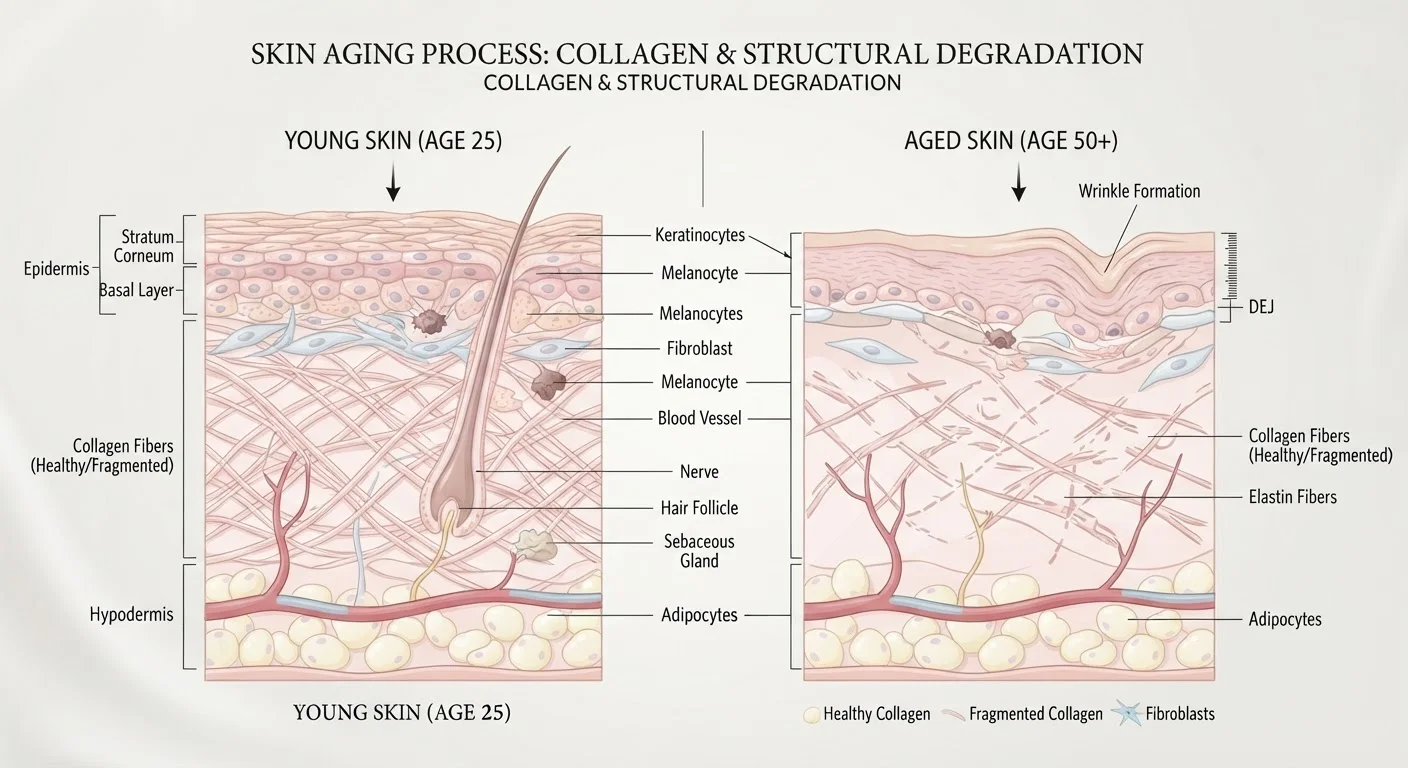
Photo credit: SmartReads.net | Simple Search, Relevant Results
In this article
From collagen loss to cellular senescence, here's a clear-eyed look at the biological mechanisms behind aging skin.
Key Takeaways
- Skin aging has two distinct drivers: intrinsic (genetic/cellular) and extrinsic (environmental).
- Collagen production declines roughly 1% per year after age 20, contributing to visible wrinkles.
- UV exposure is the most well-documented accelerator of premature skin aging.
- Cellular senescence and chronic inflammation play a significant role in how skin ages.
- Many popular anti-aging claims outpace the science; evidence varies widely by intervention.
Two Tracks of Aging: Intrinsic and Extrinsic
Skin scientists broadly divide aging into two interacting categories. Intrinsic aging is the baseline biological clock - genetic programming that determines how quickly cells replicate, repair DNA damage, and maintain structural proteins. It proceeds regardless of lifestyle or environment. Extrinsic aging is layered on top, driven by cumulative external stressors: UV radiation, air pollution, tobacco smoke, and repetitive mechanical stress from facial expressions and sleep posture.
These two tracks are not independent. Sun exposure, for example, accelerates the same collagen-degrading pathways that intrinsic aging triggers, compressing decades of biological change into shorter timeframes. Understanding this distinction matters because extrinsic factors are largely modifiable - which is where evidence-based skincare intervention has the clearest impact. For a deeper look at UV's role specifically, see the case for daily sun protection.
~1%
Annual collagen decline after age 20
Dermatological research consistently estimates a roughly 1% per year reduction in dermal collagen synthesis beginning in early adulthood.
Up to 80%
Visible aging attributed to UV exposure
Studies in dermatology literature suggest that the majority of visible facial aging stems from extrinsic factors, with UV radiation as the primary driver.
3 layers
Distinct skin layers affected by aging
The epidermis, dermis, and hypodermis each undergo measurable changes with age, affecting everything from barrier function to structural support.
The Structural Changes Underneath
Visible aging - wrinkles, sagging, thinning - reflects changes happening at the tissue and cellular level. Three structural proteins anchor youthful skin: collagen (provides firmness and structural integrity), elastin (allows skin to spring back), and hyaluronic acid (retains moisture and volume). All three decline with age.
Collagen production is estimated to fall by approximately 1% per year after age 20, according to dermatological research. Simultaneously, enzymes called matrix metalloproteinases (MMPs) - activated by UV exposure - actively break down existing collagen. The dermis (the skin's middle layer) grows thinner, reducing its ability to support the surface layer above it.
The skin's outer layer, the stratum corneum, also becomes less efficient at retaining water as ceramide levels drop with age. This explains the drier, less plump appearance often associated with aging skin - it is a functional change, not merely a cosmetic one.
“Photoaging accounts for the vast majority of age-associated changes in skin appearance. The good news is that it is largely preventable.”
— Dr. Barbara Gilchrest, Dermatologist and researcher specializing in skin aging, Boston University School of Medicine
Cellular Senescence and Inflammaging
One of the more active areas of aging research involves cellular senescence - the state in which cells permanently exit the cycle of division and renewal but remain alive and metabolically active. Senescent cells accumulate in aging skin and secrete a cocktail of inflammatory signaling molecules collectively called the senescence-associated secretory phenotype (SASP). This contributes to what researchers call inflammaging: a state of chronic, low-grade inflammation that degrades tissue quality over time.
Senescent cells in the skin are associated with impaired wound healing, reduced collagen synthesis, and disrupted pigmentation - contributing to age spots and uneven tone. This is an area of active scientific inquiry, and while it has generated interest in therapeutic applications, clinical interventions targeting senescent cells remain largely experimental as of current research.
Focus on What the Evidence Supports
When evaluating any skincare product or routine, ask which specific aging mechanism it targets and whether there is peer-reviewed evidence for that claim. Sunscreen and retinoids have some of the strongest evidence bases in dermatology. Many other products address the same pathways in theory - but with far thinner clinical support.
What This Means for Your Skincare Decisions
Understanding the biology of aging puts product and ingredient claims in sharper focus. Not every ingredient marketed as "anti-aging" actually addresses the documented mechanisms. A relatively short list of interventions has meaningful peer-reviewed support: topical retinoids (vitamin A derivatives that stimulate collagen synthesis and accelerate cell turnover), broad-spectrum sunscreen (which directly limits photoaging), and antioxidants like vitamin C (which neutralize free radicals that trigger MMP activity).
For a research-grounded breakdown of how specific ingredients work, see the evidence behind popular anti-aging ingredients. And if you want to understand which claims significantly outpace the science, anti-aging claims that don't hold up to scrutiny offers a clear-eyed review.
The biology of skin aging is genuinely complex - but that complexity is also clarifying. It highlights where evidence is strong, where it is preliminary, and where marketing has run well ahead of research. The science behind natural skincare ingredients explores how plant-based actives fit into this picture.
This article is for informational and educational purposes only and is not a substitute for professional medical or dermatological advice. Consult a qualified dermatologist for guidance on your specific skin concerns.
Frequently Asked Questions

Author
Beauty Editorial Team
Beauty Editorial Team is the collective byline for our editorial team and contributor network. Articles published under this byline or an editorial pen name are researched, written, and reviewed according to our editorial standards for clarity, consistency, and independence before publication.
View all articles →