
Anti-Aging Claims That Don't Hold Up to Scrutiny
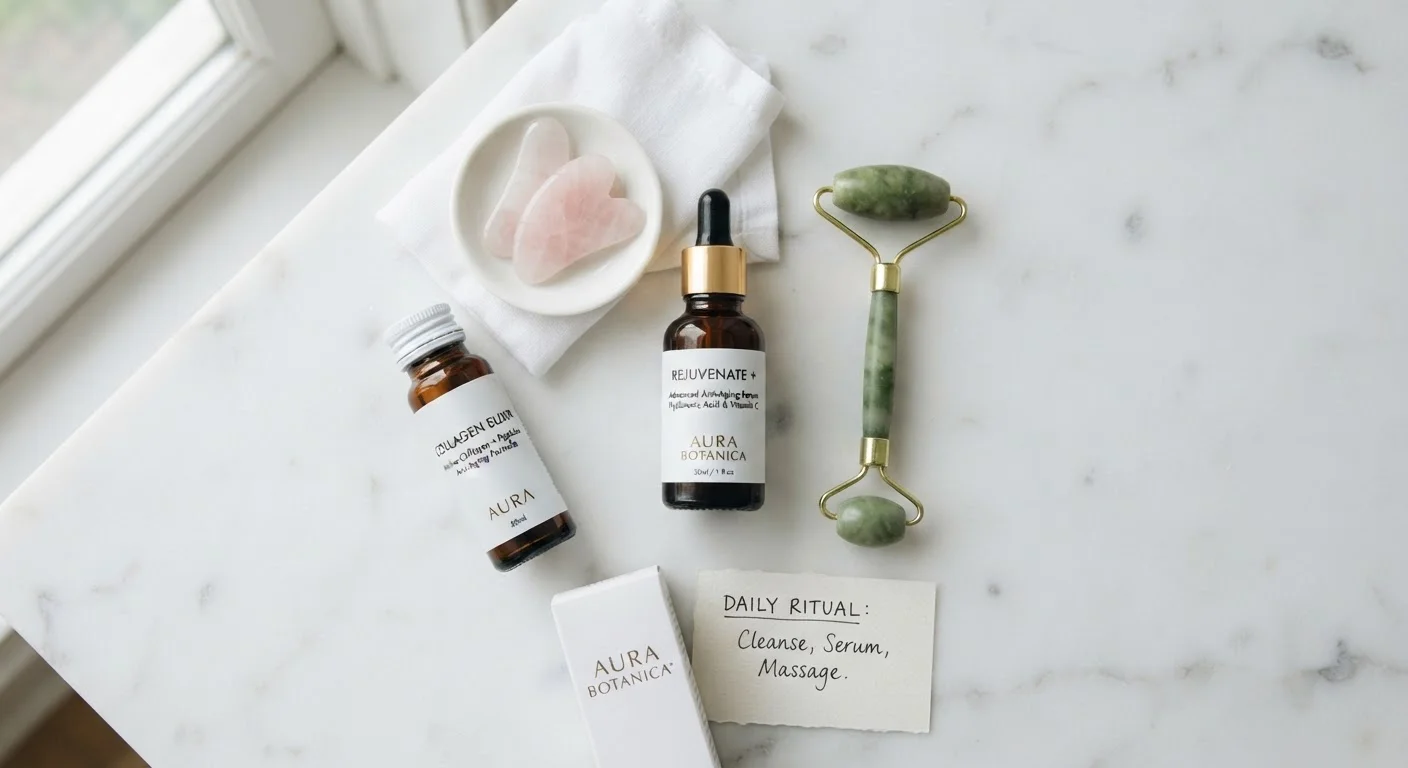
Photo credit: SmartReads.net | Simple Search, Relevant Results
Collagen drinks, jade rollers, and oxygen facials — separating marketing language from what peer-reviewed research supports.
Key Takeaways
- Oral collagen supplements face significant bioavailability hurdles; research on skin outcomes remains limited and mixed.
- Jade rollers and gua sha provide temporary depuffing but no evidence supports lasting structural skin change.
- Oxygen facials lack peer-reviewed evidence demonstrating meaningful anti-aging benefit to skin tissue.
- SPF remains one of the most evidence-backed anti-aging interventions available without a prescription.
- Distinguishing marketing language from peer-reviewed research is the most valuable anti-aging skill.
Why Anti-Aging Marketing Outpaces the Science
The global anti-aging market generates hundreds of billions of dollars annually, creating powerful incentives for brands to amplify early, limited, or industry-funded research into confident product claims. For busy consumers, parsing that language is genuinely difficult - particularly when the terminology borrows from legitimate science. Words like "collagen-boosting," "cellular renewal," and "oxygenating" carry the texture of clinical authority without necessarily reflecting it.
Understanding how skin actually ages at a biological level is the most useful foundation for evaluating any anti-aging claim. When you know what collagen loss and cellular senescence actually look like mechanistically, it becomes easier to spot when a product's promise overshoots what its mechanism could plausibly deliver.
The myth-and-fact pairs below address some of the most widely repeated claims in the anti-aging category - assessed against the weight of current peer-reviewed evidence.
Myth
Drinking collagen supplements rebuilds skin collagen directly, visibly reducing wrinkles.
Fact
Ingested collagen is broken down into amino acids during digestion and cannot be directed to skin tissue as intact collagen.
Collagen peptide supplements are marketed on the premise that consuming collagen repairs the collagen in your skin. The digestive process doesn't work that way: proteins - including collagen - are dismantled into amino acids and short peptides before absorption. Some small studies have reported modest improvements in skin elasticity and hydration, but these trials are often industry-funded, small in scale, and short in duration. The broader peer-reviewed evidence has not established a reliable, clinically meaningful skin-rejuvenation effect from oral collagen supplementation. The amino acids may contribute to your body's general protein pool, but there is no delivery mechanism that routes them specifically to facial skin collagen.
Myth
Jade rollers and gua sha tools lift and tone facial muscles, providing lasting anti-aging results.
Fact
These tools offer temporary lymphatic drainage and depuffing; no credible evidence supports lasting structural or muscular change.
Jade rolling and gua sha have genuine ritual appeal and can temporarily reduce morning puffiness by encouraging fluid movement near the skin's surface - a mild lymphatic drainage effect. However, claims that these tools "tone" underlying facial muscles or produce lasting structural lifting are not supported by peer-reviewed research. Facial muscles are not analogous to skeletal muscles in how they respond to surface-level mechanical stimulation. The tools are not harmful when used correctly, but expectations should be calibrated: the effect is temporary and cosmetic, not structural. For evidence-grounded ingredient information, the science behind natural skincare ingredients offers useful context.
Myth
Oxygen facials infuse skin with oxygen, accelerating cellular renewal and reversing signs of aging.
Fact
Skin receives its oxygen supply from the bloodstream, not from topical application; peer-reviewed support for oxygen facial efficacy is lacking.
Oxygen facials - which typically blast high-pressure streams of oxygen and serum onto the skin's surface - are popular in professional settings and carry a clinical-sounding premise. In reality, skin cells are oxygenated via dermal blood flow, not through the epidermis. The outer skin layers are not structured to absorb atmospheric oxygen in a way that meaningfully affects cellular metabolism. There is no substantial peer-reviewed literature demonstrating that topical oxygen application produces measurable anti-aging outcomes. Any visible improvement post-treatment is more likely attributable to hydration from the accompanying serum than to the oxygen delivery itself.
Myth
"Natural" or "clean" skincare formulations are inherently safer and more effective for aging skin.
Fact
Natural origin does not determine safety or efficacy; some of the best-evidenced anti-aging actives are synthetic, and natural ingredients can cause irritation.
The "natural" and "clean" beauty categories are marketing frameworks, not regulatory or scientific standards in the United States. An ingredient's origin - plant-derived versus lab-synthesized - does not determine its safety profile or clinical effectiveness. Retinoids, among the most evidence-supported anti-aging actives, are synthetic derivatives of vitamin A. Conversely, several naturally derived compounds (essential oils, citrus extracts, certain botanical acids) are well-documented irritants or photosensitizers. Natural beauty myths that dermatologists keep debunking covers this terrain in more detail. Evaluate ingredients on the evidence for their specific mechanism and safety data, not on their sourcing narrative.
Myth
Expensive skincare products work better than affordable ones because price reflects formula quality.
Fact
Price correlates with marketing spend, packaging, and brand positioning - not reliably with active ingredient concentration or clinical efficacy.
Premium pricing in skincare is driven by factors that have little bearing on dermatological performance: fragrance, luxury packaging, celebrity association, and advertising budgets. Active ingredients such as niacinamide, hyaluronic acid, and retinol are widely available across price points. What matters for anti-aging efficacy is the concentration of an active ingredient, its formulation stability, and the vehicle through which it's delivered - none of which are reflected in retail price. A dermatologist-recommended over-the-counter retinol at a modest price point may outperform a prestige serum that relies primarily on brand narrative. Always look past the marketing to what is actually in the formula and at what concentration.
What the Evidence Actually Supports
Cutting through anti-aging myths doesn't mean abandoning hope for effective skincare - it means directing attention toward interventions with genuine research backing. Daily broad-spectrum sun protection is one of the most robustly supported anti-aging strategies in the dermatology literature. See the case for daily SPF as an anti-aging tool for a deeper look at what that evidence shows.
Topical retinoids represent another area where the clinical evidence is substantial. For a side-by-side breakdown of the retinoid family, retinoids vs. retinol: two names, very different strengths clarifies potency and availability. And if you want to understand the full ingredient landscape, the evidence behind retinol, peptides, and vitamin C provides a grounded overview.
It's also worth examining your existing routine critically. Some well-intentioned habits can quietly work against skin health over time - skincare habits that quietly accelerate aging outlines the most common missteps.
Marketing Language Is Not Clinical Evidence
Terms like "clinically proven," "dermatologist-tested," and "scientifically formulated" are not regulated classifications in the U.S. and carry no standardized evidentiary weight. A single small, industry-funded study does not constitute the level of evidence that peer-reviewed consensus requires. When evaluating any anti-aging claim, look for independent, replicated research - not the language on the label.
This article is for informational purposes only and does not constitute medical or dermatological advice. Consult a qualified dermatologist or healthcare professional for guidance specific to your skin concerns.

Author
Beauty Editorial Team
Beauty Editorial Team is the collective byline for our editorial team and contributor network. Articles published under this byline or an editorial pen name are researched, written, and reviewed according to our editorial standards for clarity, consistency, and independence before publication.
View all articles →