
Generative AI vs. Traditional Automation: Understanding the Real Difference
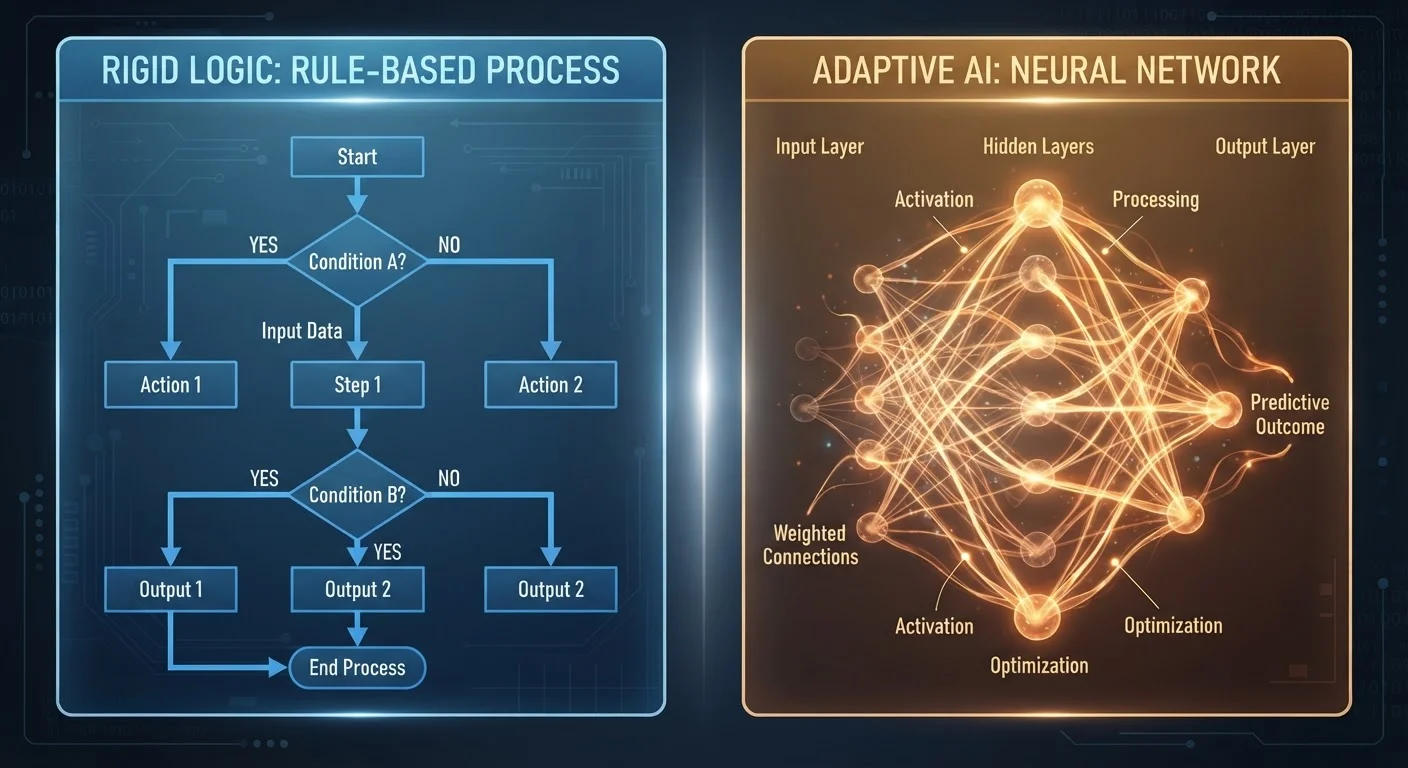
Photo credit: SmartReads.net | Simple Search, Relevant Results
Not all AI is the same. Learn what separates generative models from rule-based automation — and why the distinction matters in practice.
Key Takeaways
- Traditional automation follows explicit, pre-written rules and cannot handle situations outside its programming.
- Generative AI learns patterns from large datasets and produces novel outputs - text, code, images - in response to prompts.
- The two approaches are often complementary rather than competing; many real-world workflows use both.
- Choosing between them depends on whether your task is predictable and structured or variable and open-ended.
- Neither technology eliminates human judgment - each has distinct failure modes professionals should understand.
What Each Approach Actually Does
The term automation gets applied to everything from a spreadsheet macro to a conversational AI assistant, which creates real confusion. The underlying mechanics, however, are fundamentally different.
Traditional automation - also called rules-based automation or, in enterprise settings, Robotic Process Automation (RPA) - operates on explicit if-this-then-that logic. A developer defines every condition and outcome in advance. The system reads an invoice, checks a field value, routes it to the right folder, and logs the action. It does this exactly the same way every single time. No input outside its programmed parameters can be handled gracefully; unexpected situations cause failures, not improvisation.
Generative AI works differently at a foundational level. These models - large language models (LLMs) being the most prominent example - are trained on vast amounts of text or other data, learning statistical relationships between concepts. When you prompt one, it doesn't retrieve a stored answer or follow a flowchart. It generates a response token by token, predicting what output best fits the context. The result can be an email draft, a code snippet, a summary, or a structured analysis - none of which was explicitly programmed.
| Criterion | Traditional Automation | Generative AI |
|---|---|---|
| Core mechanism | Explicit rules and logic trees | Pattern learning from large datasets |
| Output type | Predefined, deterministic | Generated, variable |
| Handles unexpected input | Fails or routes to error | Attempts a response, may hallucinate |
| Auditability | Fully traceable logic | Probabilistic; harder to audit |
| Best task type | Structured, repetitive, rule-bound | Open-ended, language-heavy, variable |
| Setup requirement | Detailed rule authoring upfront | Prompt design and output review |
| Human oversight needed | Low for defined tasks | Higher - outputs require verification |
Understanding this distinction helps explain why generative AI feels flexible and sometimes surprising, while traditional automation feels rigid and predictable. Both qualities can be assets or liabilities depending on context.
Where Each One Belongs - and Where They Overlap
The practical decision isn't usually which technology to adopt wholesale - it's recognizing which type of task you're dealing with.
Traditional automation excels when a task is structured, repetitive, and fully specifiable. Payroll processing, data migration between systems, form validation, and scheduled report generation are classic examples. The rules don't change, the data formats are consistent, and correctness means doing the same thing the same way every time. In regulated industries like finance and healthcare, that auditability is not just useful - it's often required.
Generative AI earns its place when tasks involve language, ambiguity, or variation that no finite ruleset could anticipate. Summarizing a stream of customer feedback, drafting personalized responses, translating nuanced communications, or helping a team brainstorm solutions - these require the kind of contextual flexibility that generative models are designed for. That said, generative AI can also produce confidently incorrect output (a phenomenon called hallucination), which means human review remains essential.
~80%
Of enterprise tasks suited to rules-based automation
McKinsey research consistently estimates that a large share of automatable work involves predictable, structured activities rather than judgment-dependent ones.
3-5x
Productivity uplift reported for drafting tasks with AI assistance
Multiple controlled studies, including research published by MIT, have found significant time savings when knowledge workers use LLM tools for writing and summarization tasks.
In many mature workflows, both technologies coexist: a rules-based system handles structured data ingestion and routing, while a generative layer handles the interpretation, drafting, or summarization step. The pipeline is not AI versus automation - it's each doing what it does best.
For a grounded look at how AI fits into professional decision-making without replacing it, see common AI misconceptions worth examining. And if you use generative tools regularly, it's worth understanding what data these apps process and how to think about your own boundaries.
Neither Technology Is Self-Correcting
A rules-based system fails silently when data doesn't match its expected format. A generative model can produce plausible-sounding but factually wrong output. In both cases, the failure mode is different but the need for human oversight is the same. Building review steps into any automated workflow - regardless of the underlying technology - remains a professional best practice.

Author
Technology Editorial Team
Technology Editorial Team is the collective byline for our editorial team and contributor network. Articles published under this byline or an editorial pen name are researched, written, and reviewed according to our editorial standards for clarity, consistency, and independence before publication.
View all articles →