
End-of-Season vs. Mid-Season Sales: What the Discounts Are Actually Telling You
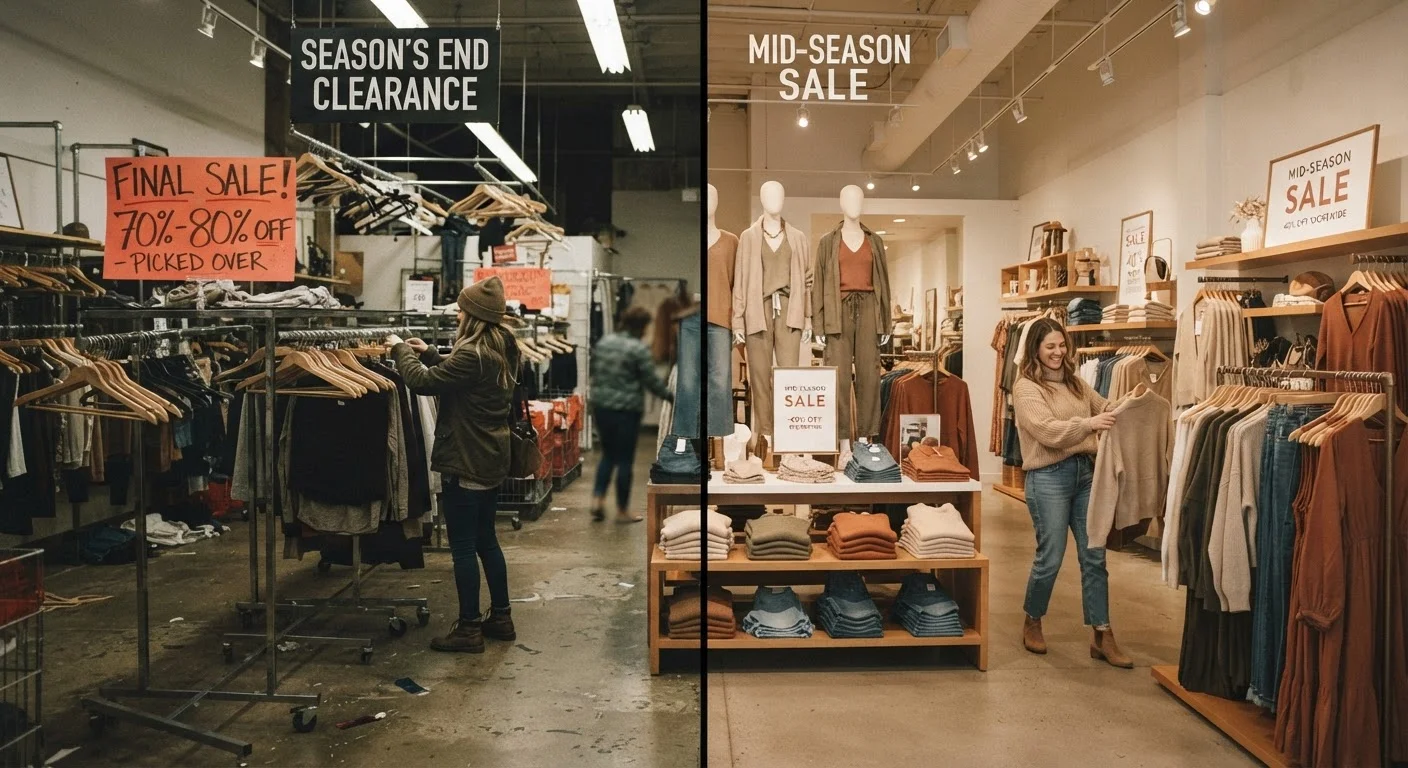
Photo credit: SmartReads.net | Simple Search, Relevant Results
In this article
End-of-season and mid-season sales serve different retail purposes. Understanding the difference helps you decide when to wait and when to act.
Key Takeaways
- End-of-season sales reflect genuine inventory pressure - retailers need space, so discounts are typically steeper.
- Mid-season sales are usually retailer-driven promotions designed to stimulate demand, not clear stock.
- Selection narrows sharply at end-of-season; mid-season sales offer fuller inventory across sizes and styles.
- The deepest discounts often come too late to be practical - sizing gaps and discontinued stock reduce real value.
- Understanding which type of sale you're in changes whether waiting or acting now is the smarter move.
Why the Timing of a Sale Is the Signal, Not the Discount Tag
A 40% discount sign tells you almost nothing on its own. What actually matters is why that discount exists - and the answer is almost entirely dictated by where the retailer sits in the seasonal cycle.
Retailers operate on predictable inventory calendars. When a season closes, unsold merchandise becomes a liability: it occupies warehouse space, ties up capital, and will be even harder to sell next year if held too long. That urgency produces end-of-season sales. Mid-season sales, by contrast, are usually planned promotional moments designed to keep traffic and revenue flowing during otherwise slow stretches - they're engineered, not reactive.
Understanding the full retail calendar is the foundation for reading these signals correctly. Once you know when seasons turn for a given category, you can tell whether you're watching a retailer get rid of stock or simply run a campaign.
End-of-Season Sales: Inventory Pressure Creates Real Discounts
End-of-season sales are structurally different from most promotions because the retailer's incentive to move product is genuine and time-bound. By late winter or late summer, the logistics math is simple: carry the inventory forward (costly and risky) or slash the price and clear it now.
This is what produces the steepest discounts in the retail cycle - often meaningfully deeper than anything seen mid-season. But the selection trade-off is significant. Popular sizes disappear first. In apparel, extra-small and extra-large tend to linger; in footwear, mid-range sizes vanish quickly. In electronics or home goods, discontinued colorways and older model-year items dominate late-clearance racks.
The practical implication: end-of-season sales reward flexible, forward-planning shoppers. If you know you'll need a winter coat next year and can commit to limited color options today, the math often works in your favor. Seasonal pricing patterns by category help identify which product types see the most reliable clearance depth.
| Criterion | End-of-Season Sales | Mid-Season Sales |
|---|---|---|
| Primary retailer motive | Clear inventory, free warehouse space | Stimulate demand, match competitors |
| Typical discount depth | Often 40-70%+ at peak clearance | Generally 20-35% |
| Selection breadth | Narrow - popular options gone early | Wide - full size and style runs |
| Usefulness for current season | Low - season is closing | High - items are seasonally relevant |
| Best for forward planners | Yes - stock up for next year | Less so - discounts don't justify delay |
| Predictability of timing | Fairly predictable by category | Variable - retailer-driven |
Mid-Season Sales: Promotional Strategy, Not Liquidation
Mid-season sales - think January sales still early in winter, or summer promotions in late June - follow a different logic entirely. Retailers introduce them to smooth revenue curves, respond to competitors' promotions, or clear partial overstock without committing to full clearance pricing.
The result is a more controlled discount environment. You'll typically see 20-35% markdowns rather than 50-70%, but the inventory picture is dramatically better: full size runs, current season items, and products that are actually useful to you right now. For a busy professional who needs something specific and functional today, that reliability has real value.
Common assumptions about sale timing often lead shoppers to hold out for end-of-season depth on items where mid-season availability matters far more. That waiting game frequently ends in either paying full price later or settling for a compromised product at clearance.
When 'Sale' Doesn't Mean What You Think
Not every mid-season promotion reflects a genuine price reduction. Some retailers use reference pricing - comparing a current price to a 'was' price that may have been in effect only briefly. The US Federal Trade Commission has published guidance on when comparative pricing claims are considered truthful. Before assuming a discount is real, consider whether you can verify the item's typical price over time through independent price-tracking tools.
How to Decide: A Framework for Acting vs. Waiting
The choice between acting mid-season or waiting for end-of-season clearance isn't about which sale is objectively better - it's about matching the sale type to your specific need.
Ask three questions before any sale purchase. First: do you need this item during the current season? If yes, end-of-season clearance is mostly irrelevant - you'll buy too late for practical use. Second: is availability of a specific variant (size, color, configuration) critical? If yes, mid-season selection wins. Third: are you purchasing for future use with full flexibility on options? If yes, waiting for end-of-season depth is likely worth it.
Misjudging discount depth is one of the most common traps in seasonal shopping - assuming deeper always means better, without accounting for what's actually left on the shelf. A 60% discount on a size that doesn't fit is a 100% waste. Use the framework above to make the discount percentage the last variable you evaluate, not the first.
~6-8 weeks
Typical window before end-of-season clearance peaks
Retail industry analysts generally observe that clearance discounts deepen progressively over the final six to eight weeks of a merchandise season as unsold inventory accumulates.
30-40%
Average mid-season promotional discount in apparel
Industry retail data suggests mid-season promotional events in apparel categories tend to cluster in the 30-40% range, compared to steeper end-of-season clearance markdowns.

Author
Shopping Editorial Team
Shopping Editorial Team is the collective byline for our editorial team and contributor network. Articles published under this byline or an editorial pen name are researched, written, and reviewed according to our editorial standards for clarity, consistency, and independence before publication.
View all articles →